Latest Entries »
Dearest Seekers of Truth and Meaning:
I read Harav Yitzchak Ginsburgh’s words about Rosh Hashanah and his comments about the last 2 parashot. (click on link below) What more can I say?
He is so inspiring, and it is a blessing to feel close to his wisdom and to his ta’anug / pleasure.
I want to remind myself that one of the ways to define spiritual life is the ability to experience pleasure;
to keep it in the body / mind / feeling. To live spiritual life is to develop the capacity to experience pleasure and to extend its presence in ourselves – you may call it being closer to God.
I would like to add two point to what Harav Ginsburgh says:
Alef (1)- about the Letter Gimel which is the change from the year 5572 to 5573 (ג)
Beit (2)- about waiting for The Messiah.
Alef – Every year a new light is coming to the world. The Letter Gimel is what is new for this coming year, since it will be the year 5573. (Letters in Hebrew are numbers.)
The Light of the Letter Gimel is what will be new this time
What is Gimel?
She is a cosmic force/energetic key that reinforces the ability to bring into this world of manifestation that which we wish for the most deep inside ourselves.
No matter how deeply it is covered by force
of negativity, fears, ignorance, stagnation and the usual.
May this light appear in this coming year!
And if this deep wish is the longing to bring the Messiah to this world,
it takes me to Bet, the second point:
Waiting for the Messiah, the one that will bring a change on a big scale. (Not necessarily The Teacher… but more The One who can manifest…).
Harav Ginsburgh mentions this person in the singular form, which it would be a one being, and I wonder …
if the time comes to think about it in the plural form, not as one person but as an increasing unity of the many that start to realize themselves, the meaning of their lives and of life on earth …
and, one by one, adding to the weight of this consciousness of awareness and realization, thus causing a change on a big scale.
I see that I write it in the present tense not the future.
Gimel is already in action…
Shanna Tovah / shinui tov / a good change.
Stay close to the Hebrew…
And
Chag Sameach – a joyful holy-day
Gilla
A Message for the New Year 5773 from Harav Yitzhak Ginsburgh
I hope the holy-day of Fire, Lag B’Omer, was experienced with meaning.
Some of you know that I was up north twice lately. I was with Rabbi David Zaslow’s community in Ashland OR, where Reb Zalman and a Sufi led a shabbaton together! I also was invited to Mt. Shasta CA where I offered the teachings on the 22 Hebrew Letters. In both places, which were very different in character, the Letters were received with great interest. Many feel that there is something in these Letters and are open to receiving their message. This is one of the signs of the paradigm shift; the Letters will be spread and women will teach them.
At the end of Shabbat on the evening of May 26, 2012, we complete the 49 Days of Self Examination and begin the long-awaited holy-days of Shavuot, celebrating Matan Torah, the receiving of Torah.
It is customary to celebrate the event by studying Torah. I wonder about creating and maintaining a sense of celebration when studying.
I liked what Rabbi Adin Steinsaltz says about the voice that was described in the revelation on Mt. Sinai: it was a loud voice that was heard all over, he says, but not only there at a certain time and place, but a voice which constantly sounds itself and is constantly available to us.
I am being reminded that the message of the Letter Vav is that very truth. She is about the availability of a level which provides the experience of connectivity of all things, that leads to the experience of wholeness.
Vav is the preposition letter “and”. Many opening sentences or chapters in the Torah start with a vav: “V’ … “meaning “And … “, “And God said/says to Moses tell children of Israel …” Vav was turned into “the reversing Letter” which means God actually told (past tense) Moses because the story belong to the past.
Today Vav reveals this meaning that Rabbi Steinsaltz speaks about: a voice or vibrations that go on for all times.
Vav at the beginning of a verb in the Torah does not belong to any particular tense; the verbs are ongoing, connecting all tenses, eternally moving in the now. This Letter is about the connectivity of all things in creation. Moses is still talking to Children of Israel, and we are still listening.
Metivta will hold a Leil Shavuot at Leo Baeck Temple, Saturday, May 26, 8 – 11pm. All are welcome. For more information: http://www.metivta.org/Default.asp?page=19
We have moved into the month of Nissan, the head month of the Jewish calendar. It has the power to charge all the other months of the year, since it is governed by signs of miracles and redemption, giving us the ability to receive messages. The miraculous aspect has to do with the power to discover the new reality we wish for. It is already there, waiting to be claimed and fulfilled. We are charged to move from potentiality to actuality.
We are guided by a constellation of the Letters Peh, Sameh and Chet (PeSaH), especially contemplative signs and symbols that can lead one deep into ourselves. From that depth expansion of awareness. The concentric circles moving out to include new unrecognized horizons and possibilities.
All of this happens with the power of passion, love and compassion, important ingredients in this movement from slavery to freedom.
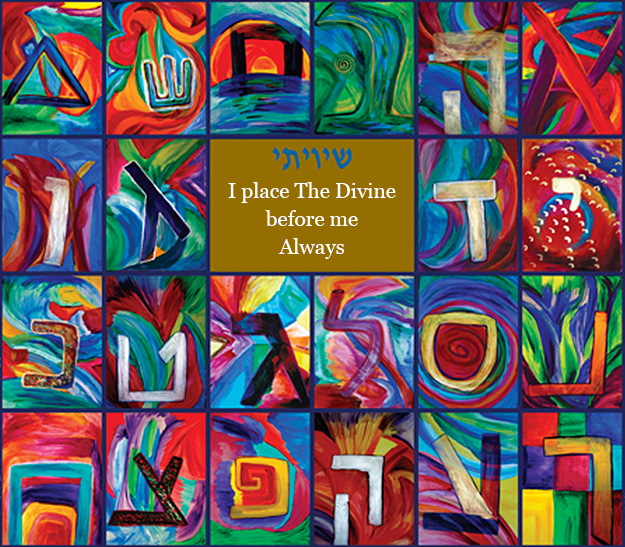
To Purchase the Shiviti poster please go to the Gallery page.

This time, with the readings of both the end and the beginning of the Torah,
is under the sign of the last of the 22 Letters, the Letter Tav. She is a cosmic power
than is concerned with: the beginning, the middle, the end and a the new beginning,
just like the 4 lines of her physical form:
תתתתתתתתתתתתתתתתתתתתתתתתתתתת
the true cyclical nature of life which has no beginning or ending.
Moses, the most dedicated shepherd, is completing his task and leaving the scene.
At the age of 120 years he is still fully conscious and vital. In the last shabbat service
we said kaddish also for him. The cantor was teary-eyed.
But again, as I sat in that morning service and heard people debating over
how Moses was prevented from coming to the Promised Land, I had the same impression as in the past:
this is not a punishment . Our religion is not that childish.
Punished, for what?
Moses, the highest servant of God, a man who saw God “face to face”, simply in a physical body,
can not see it all. No one can.
There are levels of truth which can not be reveled to us as long as we are in a physical body.
Even not to Moses, the highest of all human beings.
The three upper sphirot of the Tree of Life, are known to be simply un graspable to human mind.
The Promise Land will always on some levels be only promised,
and no one can enter her and fully see her.
The bigger picture stays unknowable. This is a mystery we can live with …
It still leaves so much that we can understand and see.
Then, the first chapter of B’reisheet / Genesis was read. I was hoping that, by now,
after all the studies that we have done,
it will be read in any other way than “In the beginning”.
What could be more appropriate than reading it as:1- in a beginning,2- at first, firstly,3- with the “head”.
Anything but “in the beginning”. “The” is a word which has never been written in Hebrew and a mistranslation
which has mislead the world for generations. A whole civilization/ way of thinking was build on this mistake/false notion
(one static perfect God as in the Aristotelian thought, one beginning of creation etc)
and we continue to say “in the beginning”. How long will it take to do what we know is right to do:
eliminate this misleading interpretation. Even when the truth is revealed to us, we still cannot embrace it fully.
Not yet, but it is entering our consciousness slowly.
Dear God, forgive me, I think like a person
who watches too much CNN, but then I do return
To be under the wings of Your inspiration.
How You throw on me Your glimpses of Hope.
Like fresh water over the perplexed.
I want to know Love,
I want You to know me and name me again.
All day I was your clumsy pupil.
How hard I make you work.
I forget and then you remind me to remember.
How I long today, to be under Your Letters.
Under your serene silence.
Now, the shadows fall over the city, things have changed.
The crickets and the humming of a tired computer.
I can listen to You, all dressed in awesome wholeness.
It’s been a long demanding first day of the year.
Fall 2011
10-10- 11
Thank you for joining the retreat followed by our Kabbalat Shabbat last Friday.
It seems that many benefited, and recognized what we are trying to create for ourselves, a Jewish contemplative circle — which will be neither a zen event, nor a social club, but a place to share our passion for Truth, and our search for the meaning of our life.
We seek a balance of both sincerity and lightness. In Hebrew we call it “to be with the right kavanah/intention at all times.” Self-evaluation/prayers and engaging in higher matters become our life directions.
We are trying to find the tools to maintain alignment among what Rabbi Nachman calls the “feelings of the body,” the mind, and the emotions.
Another aim is to start using the Shefa/positive blessed energy that appears in order to actualize our wishes and hopes.
We want to be specific and request them by seeing them in our mind, and using the power of speech.
It is with the power of speech that the Jewish people were asked to witness the Divine on earth.
I wish us all to envision what we really need for ourselves and others around us. Perhaps we have not yet discovered our full possibilities. Perhaps we have not really started to pray for our kids, our family, our community, our planet.
I am still very defensive or attacking or “in shock” about life. But life is not a monster. I need to break from the grasp of these three habitual options, and move to the next one: seeing the change, contributing towards an ascending direction, closer to the miraculous.
The rest is usually negative and serving its grabbing, hypnotic, lower nature.
We wish to see the change, the “shanna” from the word shinui/change. We finally know what to ask for. We know that gratitude is Number One on the list. May we merit gratitude, the well-being of the body/mind/feelings to carry our life’s aims. Servicing higher aims provides us with what it takes to execute them: courage, hope, love, clarity, vision and attention.
How do I ask for what I really need?
The new year is in the sign of the Letter Gimel (3). This letter, as some of you know, is about the ability to move things from potentiality to actuality, to materialize (hitgashmut, gashmiyut) what we really need, that which was hidden from us buried under dust, fears, habits, disbelief, etc. May we learn to use the Gimel energy this year.
Amen.
Last but not least, I am delighted to announce that there is an interest in our circle to discover/experience the work in the kitchen as holy work. We will work on introducing it into our work together in a planned manner, with more working space in the kitchen, etc.
May all our exchanges about the meaning of Torah, rituals and conscious deeds attract Shefa/Abundance that is noticeable to us.
May we have what it takes to see it and may we be as fruitful as the pomegranates in the photo Joy took in the front garden.
Amen
Gilla Nissan
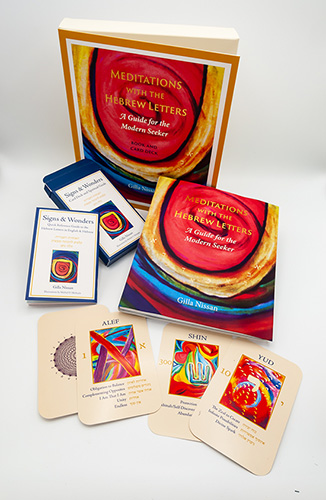
“They have arrived from the source of unconditional love to expand our hearts and life – You can only say yes to them. This is an old study based upon new principles of learning. Its Zoharic depth and feminine nature are conveyed by means of direct experience. Using our senses while observing our presence in the given moment, enable us to take in this material and experience inner expansion. We can see a beginning of possible change.
There are ongoing courses on the Letters in both the west side and Sherman Oaks.
Please contact me for more details at: gilla29 (at) msn (dot) com
Gilla Nissan © All rights reserved
Illustrations by Michal Ohayon
To order the poster please contact me at: gilla29 (at) msn (dot) com
Gilla Nissan: What do the sources of Jewish tradition tell us about suffering?
Rabbi Omer-Man: Within the Jewish tradition, though perhaps we should say traditions, there are numerous reflections on the topic of suffering. These come from a range of perspectives; some emphasize the locus of the suffering, be it the individual human being, the group, the nation as a whole, or universal. Others are more concerned with the causes of suffering, if it is a consequence of one’s actions or not; whereas yet others are more concerned with appropriate responses to suffering. And underlying all of these is the question of the meaning of suffering: how could a just benign God permit such pain to exist? From the earliest Biblical sources, through the medieval commentaries, philosophical, literary writings, and later Hasidic works, writers struggle with the issues.
Let’s look first at the suffering of an individual. Of course the biblical Book of Job jumps to mind. It is clear from the story that Job’s many tribulations were in no way the consequences of his actions, but rather of a strange wager between God and the Satan. Job was not iniquitous, he did nothing wrong; he lived a basically righteous life. His sufferings appeared to be random, inexplicable; they just happened. At first he seemed to be able to live with his grief, until his friends arrived and sought to console him with philosophical, religious, and moral ideas. He was broken not by a series of catastrophic events, but by their attempt to impose extraneous meaning on it all. That was the point at which he lost his equanimity, at which famously he cursed his fate.
Lauren Deutsch: So, in their effort to console, they only reinforced the existence of badness?
R. O-M.: Yes. Eventually, Job’s wisdom came directly from God. The climax of the book is a magnificent episode in which God speaks from the whirlwind, challenging Job, asking him, in effect, “who are you to enquire after meaning?; “where were you when I created the mountains?” God seems to be emphasizing to Job how insignificant his place was in the Creation. Ultimately, I think that one of the teachings of the Book of Job is that the quest for meaning can sometimes be futile, and that our task is not to understand the cause of our suffering, why it happened, but rather to transcend the experience by accepting the mystery of existence. Asking “why me” never helps.
On the other hand, we also speak of suffering that comes about as a result of human actions. In this respect we can look at in the Jewish fast day of Tisha be’Av, the 9th of Av, which commemorates the destruction of both of the Holy Temples in Jerusalem. Our sources all relate that the immediate cause of this was immorality on the part of the inhabitants of the city. It wasn’t a proportionate consequence – desecration and exile of the entire nation following gossip and defamation. But nevertheless it was a consequence of our actions.
GN: Last Tisha b’Av we learned that while we mourn the loss of our Temples of the past, we are also mourning the loss of our sense of holiness within ourselves today. Can you provide some thoughts about this?
R. O-M.: Yes, this is one of the characteristics of the Jewish understandings of history, that the past is echoed in the present, or that the patterns of the past can illuminate and inform the present. When we commemorate and study the destruction of the Temples, we become aware of how he have desecrated the promise of holiness in our own lives..
There is a perfect example of this is in a hasidic interpretation of the experience of the Children of Israel in their Exodus from Egypt. I’m not going to recapitulate the entire story, just talk about one aspect of it. To start with, it’s important to establish the difference between pain and what in this context we can call wretchedness. Pain is factual, it is extreme discomfort, physical or mental, or both. Wretchedness (the Hebrew word is ʿatzvut), on the contrary, is not “real,” it is a psychic construct that serves to buffer us from experiencing unbearable pain. In the short term it is an essential mechanism, and can keep us sane, but when maintained for too long it creates major spiritual problems.
A central idea in the Jewish mystical tradition is that everything in the world, animate and inaminate, is sustained by the Divine presence; this includes every living creature, every star, every planet, every particle, but also events and even states, like joy and pain, life and death, everything. When we buffer ourselves from any part of the world, we are also veiling the Divine presence that resides within it. The corollary is true. When we veil ourselves from the Divine presence within the world, we veil ourselves from the Source, the All, the One, the Infinite. This is wretchedness: being totally bereft and alone in the world.
What happened with the Children of Israel was that in the initial stages of their slavery they buffered themselves against the pain: they grumbled, they complained, but somehow they made slavery comfortable. Their coping mechanism was to restrict their vision: they lost their sense of identity, and fell into a sense of melancholic non-action. “This is the way it is.” “Maybe we can’t take cruises down the Nile, but we’ve got enough food to eat, somewhere to sleep, and the workload is bearable.” They fell into the trap of self-pity, true wretchedness. They cut themselves off from both the Divine presence in the world and from the Source, the One. They were wretched and alone, and hopeless.
Then Moses arrived on the scene. He came from the outside, and so was not involved in their dramas. In order to create a shift, a movement, he proceeded to exacerbate matters: he provoked Pharaoh into worsening the conditions of their slavery, to make their life so unbearable that no buffering could shield them. Then they moved into the condition known in Hebrew as merirut, bitterness. Their situation was no longer tenable. They realized that there was a choice. “We don’t want to live this way.” They smashed the shell of wretchedness, and the Exodus began.
Lauren Deutsch: He raised the stakes?
R. O-M.: Yes, and the Exodus from Egypt also serves as a paradigm for situations in our own lives. The provocation of a good friend can rescue us from the isolation of wretchedness; but of course it must be employed with caution.
Let’s change the subject. Chapter 53 of the Book of Isaiah offers a completely different approach, that of redemptive suffering, the suffering of an individual that can transform not just that person, but all of society, perhaps even the cosmos. This is the “suffering servant,” the individual whose suffering takes on the pain of the world. Christianity adopted this and invested it in the figure of Jesus. Partially as a result, many Jews withdraw from this position. There has never been a consensus as to whether this “suffering servant” is an individual or the entire Jewish people.
Rashi (an 11th century commentator), for example, held the latter position, that the community of Israel bears the pain of the world, and that the world can be redeemed through its efforts. Whereas, others, such as Rabbi Nachman of Breslov (1782-1810, an important Hasidic leader), speak of how the tzadik, the righteous person, the fully realized human being, can take on such suffering in a way that is transformative.
GN: Not everyone’s a tzadik. What does Rabbi Nachman advise the rest of us to do when we are confronted by a situation that has the potential to cause us suffering?
R. O-M.: In some very complex essays he described the manner in which suffering can drag you down when you identify with it, if you embrace the role of victim. If the entire locus of one’s being is suffering, one’s bruised self, one’s bruised existence, then suffering cannot be redemptive. He suggests that one can refine one’s strategy. To avoid being overcome by pain we need to shift our focus to the transcendent, to move out of a state of wretchedness and enter into a world in which light and darkness are commingled.
Not for a moment am I suggesting that all suffering is voluntary. There is terrible pain and distress in the world. What I am referring to is the fact that we can develop a predisposition to wretchedness, to feeling safe with it, consoling oneself. To overcome that, we must learn to remove the “poor me” from the equation. Moving away from “poor me, I have I have terrible arthritis in my knee,” to “I have terrible arthritis in my knee”. Don’t get me wrong, feeling sorry for oneself can be a necessary defensive measure, but only if it is temporary, a kind of dullness before the necessary sharpness. It’s in the sharpness that suffering can become redemptive.
LD: Is the goal to remain in that protective stage for as long as possible?
R. O-M.: The image I’d like to use is of a cast on a broken limb. It facilitates healing in the short term, but unfortunately some people want to keep it on indefinitely. It is no longer appropriate. But removing it also takes courage. Removing a cast can be painful too.
GN: Is this voluntary suffering?
R. O-M.: Let’s call it “locked into wretchedness”. It’s a terrible place. And one often needs an external shock to break out of it. Like Moses’ entering the scene and shaking up the Children of Israel. I think that all of us sometimes in our lives need such interventions.
The question is: How does one remove oneself from attachment to suffering, how does one prevent oneself from defining oneself by one’s wretchedness? Pain is unavoidable, wretchedness is not.
‘
GN: Can suffering be a means to deepen one’s spiritual work?
R. O-M.: Suffering is a necessary phase of existence. There is an ebb and flow within the spiritual life, between a sense of desolation and that of consolation. Both are essential. Consolation is a sweet gift that comes from the Divine, from the beyond. It is a kind of gift of grace. One of the problems of our times is that people want to feast on the consolation without ever tasting the desolation. So much of our society is built around that denial of desolation. We rush to the freezer and go straight for the figurative Hagen Daasz. That’s subsisting on consolation, which is a very unbalanced spiritual diet.
GN: There’s still something I want to understand about the ability to stand in front of something difficult and bear it. Where does this ability come from?
R. O-M.: There are different soul attributes, different virtues on the path that we cultivate in our work, and in this respect courage is primary. Not macho courage, but soul courage. There is something else. When I visited His Holiness the Dalai Lama and his community in Dharamsala, I was struck powerfully by their ability to maintain lightness in adversity. That is something I took away from there, a precious life teaching.